

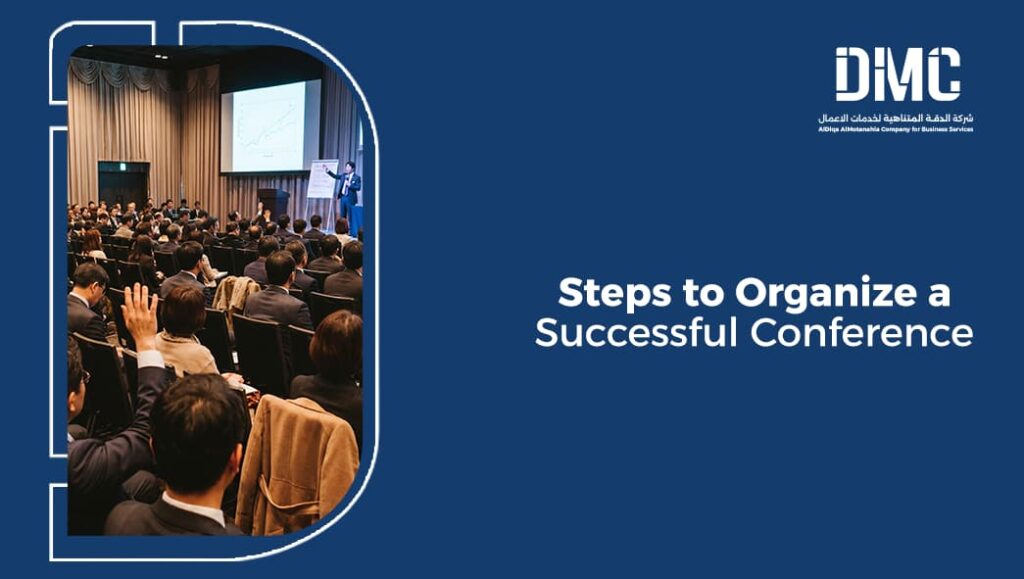
Organizing a successful conference does not depend only on booking a venue or inviting speakers. It requires careful planning that connects the objective, audience, budget, content, and the full attendee experience.
Every detail, from registration to the closing session, affects the image of the organizing entity and the extent to which the conference achieves its goals. Therefore, understanding the steps to organize a successful conference helps organizations manage events professionally, reduce operational mistakes, and turn the conference into an effective tool for building relationships and strengthening institutional presence.
What Is Conference Organization?
Conference organization is an integrated planning and coordination process aimed at bringing together a specific audience to discuss a particular topic, industry, or issue through sessions, keynote speeches, workshops, or professional meetings.
Conference organization is not limited to logistics only. It also includes content management, speaker selection, attendee experience design, supplier coordination, marketing, and operations management on the day of the event.
In simpler terms, organizing a conference means turning an idea or strategic objective into a structured real-life experience that serves both the attendees and the organizing entity.
Why Does a Conference Need Prior Planning?
Any conference without clear planning can turn into an event overloaded with uncontrolled details. The content may be strong, but poor registration, delays, or weak venue management can leave a negative impression on attendees.
Prior planning helps to:
Define the real objective of the conference.
Choose the right audience.
Control the budget and expenses.
Organize the agenda and speakers.
Prepare the venue, technical setup, and hospitality.
Reduce operational risks on the event day.
Measure results after the conference ends.
Therefore, the success of a conference begins well before the event day, not only during execution.
Steps to Organize a Successful Conference:
1. Define the Objective of the Conference
The first step in organizing any conference is to define the objective clearly. Is the goal to build relationships? Launch a product? Exchange knowledge? Attract investors? Strengthen the company’s image? Or bring together experts from a specific sector on one platform?
A clear objective helps make better decisions at every following stage, from choosing speakers and the audience to designing the agenda and measuring success after the conference.
A conference targeting investors differs in its design and messaging from a training conference, awareness conference, or media-focused event.
2. Identify the Target Audience
After defining the objective, the audience must be identified accurately. Who should attend the conference? Are they executives, investors, potential clients, partners, specialists, government entities, or media representatives?
Understanding the audience helps design a suitable experience for them, whether in terms of content type, speaker level, communication language, invitation method, or even venue and timing.
The more specific the audience is, the more impactful and less random the conference becomes.
3. Prepare the Budget
The budget is one of the most important steps in organizing a successful conference because it defines the scope of execution and the quality of the experience.
All expected items should be identified before starting, such as:
Venue cost.
Technical equipment.
Hospitality.
Design and printing.
Marketing and advertising.
Registration management.
Speaker or guest fees.
Photography and documentation.
Organization and operations team.
A contingency budget should also be allocated because events often face unexpected expenses. An accurate budget does not mean reducing quality; it means using resources more intelligently.
4. Choose the Right Venue and Timing
The choice of venue directly affects conference attendance and participants’ impressions. The location should be easy to access, suitable for the number of attendees, and equipped with essential services such as sound, presentation screens, internet, parking, and reception.
Timing should also be selected carefully to avoid conflicts with holiday seasons, major events, or busy work periods for the target audience.
Venue and timing are not secondary details. Strong content may still fail to attract attendance if the venue or timing is not suitable.
5. Design the Conference Agenda
The conference agenda is the backbone of the event. It should be organized, clear, and balanced between keynote sessions, discussions, breaks, and networking time.
It is also important to choose speakers who are aligned with the conference objective, not just well-known names. A good speaker is someone who provides real value to the audience and supports the conference’s message.
Time management should also be considered carefully, as delayed sessions or an overloaded agenda can reduce the quality of the experience.
6. Prepare the Visual Identity and Informational Materials
A successful conference needs a clear identity that appears in invitations, the website, posters, screens, attendee badges, signage, and social media platforms.
The visual identity helps create a professional impression and unify the attendee experience from the first invitation to the end of the event.
Informational materials should also be prepared early, such as the conference agenda, speaker bios, venue map, attendance instructions, and any files or presentations that will be used during the sessions.
7. Market and Promote the Conference
Even if the conference is strong in content and organization, it will not achieve its goals if it does not reach the right audience. Therefore, a clear marketing plan should be prepared well before the conference date.
The plan may include:
Digital advertising campaigns.
Email marketing.
Official invitations.
Communication with partners and sponsors.
Publishing on social media platforms.
Media coverage.
A clear and easy-to-use registration page.
Marketing is not only about increasing the number of attendees. It is about attracting the right attendees for the conference objectives.
8. Manage Registration and Attendee Reception
The attendee experience begins from the moment of registration, not from the first session. Therefore, the registration process should be simple, whether it is online before the event or on-site on the day of the conference.
On the event day, clear reception points, an organized team, attendee badges, venue directions, and a fast entry flow should be prepared to reduce crowding.
Any issue in registration or reception may create a negative impression, even if the conference content is strong.
9. Manage Logistics Operations
Logistics are the details that attendees do not notice when they run smoothly, but they notice immediately when something goes wrong.
This stage includes preparing sound, lighting, screens, internet, live streaming, hospitality, seating, translation when needed, parking, speaker movement, and attendee entry and exit flow.
Therefore, a detailed operations checklist should be prepared before the conference, with a clear person responsible for each area or task.
10. Manage the Conference Day
The conference day is the real execution test. There should be an on-ground team that clearly understands its tasks, along with a detailed operations plan covering session timing, speaker reception, technical follow-up, attendee management, and emergency handling.
It is better to have an operations room or central coordination point to monitor all details moment by moment.
The success of this day depends on prior preparation, because good organization does not leave important decisions to the last minute.
11. Evaluate Results After the Conference
Conference organization does not end with the closing session. After the event, performance should be evaluated to determine whether the objectives were achieved.
The conference can be evaluated through:
Actual attendance compared to the target number.
Attendee satisfaction rate.
Quality of engagement with sessions.
Number of partnerships or opportunities generated.
Media coverage results.
Marketing campaign performance.
Feedback from speakers and sponsors.
This evaluation helps improve future conferences and turns the event from a one-time activity into a knowledge and marketing asset that can be built upon.
Key Factors for Conference Success:
There are essential factors that separate an ordinary conference from one that leaves a real impact on attendees.
The first is clarity of objective, because an undefined conference becomes scattered in its messaging and execution. The second is content quality, because attendees need real value in exchange for their time. The third is on-ground organization, because the practical experience affects the final impression as much as the content itself.
Time management, easy registration, clear directions, hospitality quality, and the professionalism of the organizing team all help create a more complete experience.
Common Mistakes in Conference Organization:
One of the most common mistakes is starting preparations too late, which leads to pressure in decision-making and higher costs. Some organizations also choose a venue that does not suit the size of the audience or the nature of the target attendees.
A conference may also fail because of weak marketing, an unclear agenda, or reliance on speakers who do not serve the real objective of the event.
Another important mistake is ignoring the emergency plan, whether for technical issues, speaker delays, registration crowding, or any sudden change in the conference schedule.
When Do You Need a Specialized Conference Organization Company?
You need a specialized company if the conference is large, includes important guests, requires coordination with several parties, or demands a high level of organization, visual experience, and logistics management.
Working with specialists also becomes necessary if the organizing entity does not have an internal team capable of managing operational details, or if the conference is connected to the organization’s image and reputation in front of clients or partners.
At this stage, event and conference organization services from Al-Diqqa Al-Mutanahiyah help manage the conference stages, from planning and budgeting to on-ground execution and results evaluation, ensuring a more professional experience for both attendees and organizers.
How Al-Diqqa Al-Mutanahiyah Helps You Organize Conferences
Al-Diqqa Al-Mutanahiyah helps you turn the conference idea into an organized experience with clear objectives through prior planning, budget control, supplier coordination, operational detail management, and event-day supervision.
We begin by understanding the conference objective and target audience, then build an execution plan that includes the agenda, speakers, venue, registration, marketing, logistics operations, and risk management.
The goal is not only to execute a conference, but to deliver an experience that reflects the professionalism of the organizing entity and supports its institutional objectives.
Frequently Asked Questions About the Steps to Organize a Successful Conference
What are the most important steps to organize a successful conference?
The steps to organize a successful conference start with defining the objective, then identifying the target audience, preparing the budget, choosing the venue and timing, designing the agenda, marketing the event, managing registration, executing logistics operations, and evaluating results after the conference.
How long does it take to organize a conference?
The duration varies depending on the size of the conference, the number of attendees and speakers, and the nature of the required preparations. Small conferences may need a few weeks, while large conferences may require several months of planning and preparation.
What is the most important factor in conference success?
The most important factor is having a clear objective supported by prior planning. The objective determines the audience, content, budget, marketing, and method of measuring results, while planning ensures that all of this is executed without confusion.
Can a conference be organized without a specialized company?
Yes, this is possible if the organizing entity has an internal team with enough experience. However, in large conferences or events that affect the organization’s image, a specialized company helps reduce mistakes and improve execution quality.
How is conference success evaluated after it ends?
Success is evaluated by comparing results with the objectives defined in advance, such as attendee numbers, participant satisfaction, quality of engagement, number of partnerships, media coverage, and marketing campaign performance.
Understanding the steps to organize a successful conference helps organizations manage events more professionally, from defining the objective and audience to executing the conference day and measuring results afterward.
A successful conference does not depend on one element only. It depends on the integration of planning, content, logistics, marketing, and attendee experience.
Through Al-Diqqa Al-Mutanahiyah, you can organize a conference that reflects a strong institutional image and achieves your goals with the highest level of discipline and quality.
