

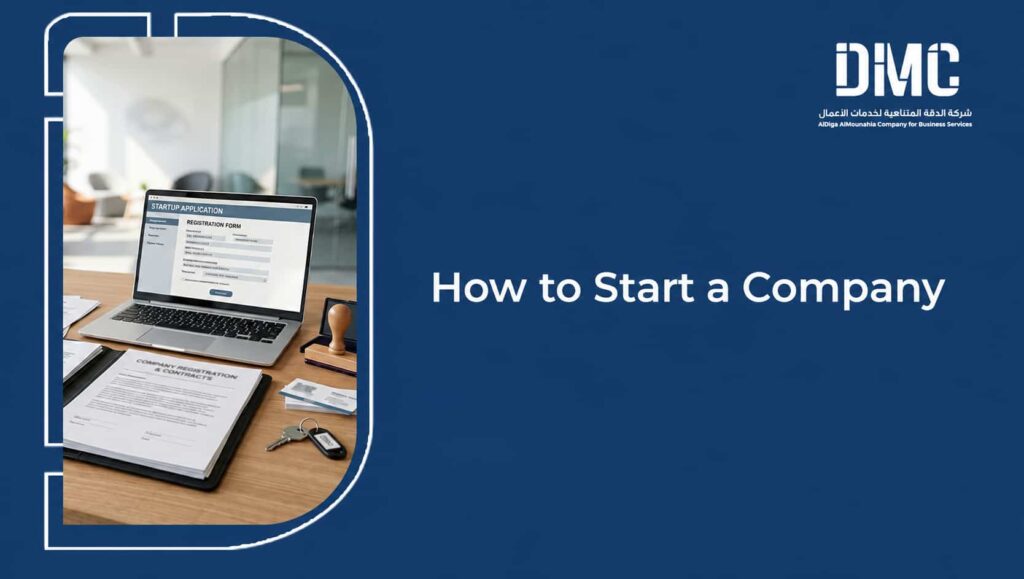
Starting a company is not just obtaining a document—it’s building a legal entity with rights and obligations. Many new founders focus on the idea and delay understanding the procedures, later discovering they have incurred legal violations that could have been easily avoided. Knowing how to start a company correctly ensures proper legal establishment from day one.
Steps to Start a Company in Saudi Arabia
In the Kingdom, company formation procedures have become digital via the Ministry of Commerce’s Business Platform, covering the following stages:
Choosing the Legal Form
The legal form affects your financial liability and management structure:
- Sole Proprietorship: Owned by one person, unlimited liability.
- Limited Liability Company (LLC): Ideal for small and medium businesses; liability limited to the partner’s share.
- Joint Stock Company: Suitable for large projects; liability limited to the value of shares.
For startups, the LLC is usually the most balanced choice between legal protection and administrative flexibility.
Choosing the Business Activity
The business activity defines the company’s operational scope and must comply with the official classifications of the Ministry of Commerce.
Some activities require prior approvals (e.g., transport, health, education).
At this stage, it is recommended to rely on company formation services to ensure the legal activity aligns with your financial and administrative systems from the start.
Drafting the Articles of Association
The articles of association grant the company its legal personality and define:
- Company name and purpose.
- Capital structure and partner shares.
- Management powers and profit/loss distribution.
Issuing the Commercial Registration
The commercial registration is the legal identity of the company, issued electronically after:
- Entering company data on the Business Platform.
- Uploading the required documents.
- Paying the annual fees.
Compliance with Government Authorities
After obtaining the commercial registration, obligations begin towards:
- Ministry of Human Resources: Register the business and insurance.
- Zakat, Tax and Customs Authority: Open zakat and tax files.
- Chamber of Commerce: Local membership.
- Municipality: Obtain necessary work location permits.
Required Documents
- Articles of association and bylaws.
- ID or residency and passport of founders.
- Proof of address.
- Prior licenses (if required by the activity).
- Capital declaration (for certain activities).
Common Mistakes
- Choosing the wrong legal form.
- Relying only on commercial registration while ignoring zakat and insurance.
- Selecting an overly general or inaccurate business activity.
- Mixing personal and business assets.
- Ignoring governance structures, even for small companies.
Role of Specialized Consulting
Through company formation services, founders can receive full support in:
- Financial planning and partner share allocation.
- Designing governance structures to protect rights and define decision-making mechanisms.
- Ensuring tax, zakat, and insurance compliance from day one.
- Linking formation with accounting systems and organizational structure.
Understanding how to start a company ensures legal compliance, minimizes financial and administrative risks, and prepares the business for growth.
FAQ
Q: Can a company be started without a partner?
A: Yes, via a single-person company, considering the legal nature of liability.
Q: What is the minimum capital for a limited liability company?
A: There is no minimum for most activities, though some specific activities require a set amount.
Q: Can the business activity be changed after obtaining the commercial registration?
A: Yes, new activities can be added or existing ones modified via the Business Platform after paying the applicable fees.
