

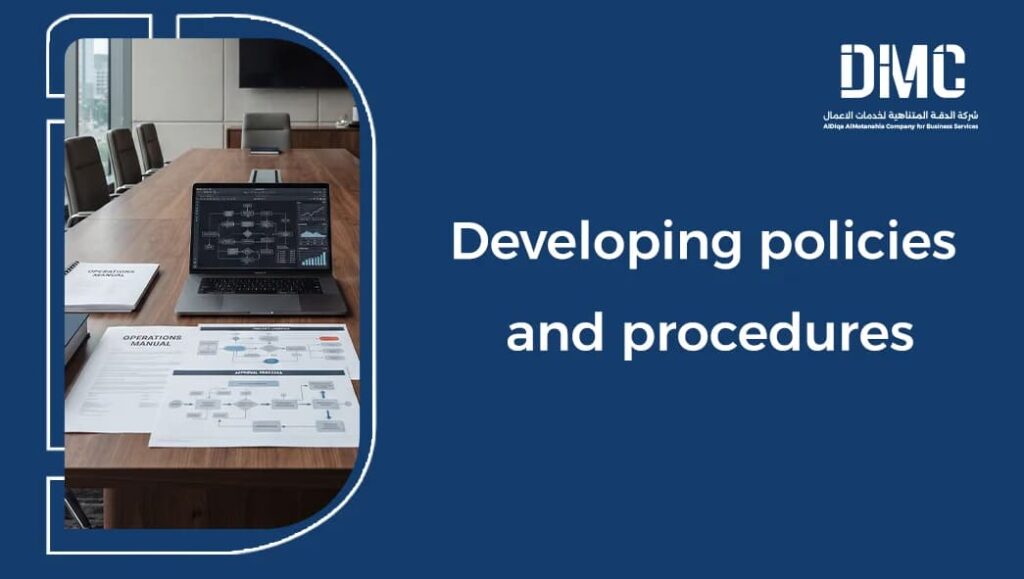
Many companies talk about institutional excellence, transparency, and operational efficiency. However, only a few have the documents that turn these goals into real practices. Policies and procedures are not just papers stored in files. They are the compass that guides employee behavior, defines workflows, and protects the organization from legal and administrative risks.
In the evolving Saudi market, and with the increasing requirements of governance and compliance, developing clear and documented policies and procedures has become a strategic necessity, not an administrative luxury. This article provides a practical guide to developing policies and procedures, from planning to implementation and follow-up.
What Is Meant by Developing Policies and Procedures?
Developing policies and procedures is a systematic process that aims to document the rules, guiding principles, and detailed work steps that govern employee performance and define how tasks are carried out within an organization.
Policies represent the main rules that define what should be done and why, while procedures explain how these policies are implemented through practical steps. Together, they ensure work consistency, reduce human errors, and provide a clear reference that employees can return to when needed.
Why Does Your Organization Need Documented Policies and Procedures?
Policies and procedures form the foundation of institutional organization. They help unify work mechanisms, define responsibilities, enhance compliance and governance, and reduce operational errors.
Organizing Workflow
Policies and procedures define the sequence of steps required to complete each task, ensuring that work flows smoothly and without randomness. Work shifts from individual judgment to a clear and organized path that everyone understands, reducing confusion and delays caused by unclear processes.
Standardizing Decision-Making
Policies create a unified framework for decision-making, so similar situations are handled consistently regardless of the person or timing. This standardization promotes fairness and transparency, prevents conflicting administrative decisions, and helps employees understand the expected outcomes of their actions.
Strengthening Corporate Governance
Policies and procedures are a core pillar of corporate governance. They define the relationship between the board of directors and executive management, clearly distribute authorities and responsibilities, and establish mechanisms for control and follow-up. They also support separation of powers and help prevent conflicts of interest, which strengthens the trust of investors and partners in the organization.
Improving Employee Efficiency
Policies and procedures help new employees understand their duties and responsibilities quickly and reduce the learning curve. They also provide current employees with a clear reference, reducing repeated questions and allowing them to focus on execution instead of asking how tasks should be performed.
Reducing Operational Errors
When everyone understands the correct way to perform tasks, errors caused by inaccuracy or wrong individual judgment are reduced. Documenting procedures also reveals unnecessary or repeated steps and helps simplify operations, which improves output quality and reduces operating costs.
Supporting Compliance With Regulations
Documented policies and procedures help prove the organization’s commitment to local laws and regulations. They provide tangible evidence for regulatory authorities when required. This compliance protects the company from fines and legal violations, enhances its reputation in the market, and supports its eligibility for licenses and official approvals.
Types of Policies and Procedures in Companies
Policies and procedures vary within an organization to cover all aspects of work. They differ according to the company’s size, activity, and organizational structure. The following are the most important types.
Administrative Policies
Administrative policies define the general framework for managing the organization. They include authority and responsibility structures, decision-making mechanisms, meeting organization, time management, and internal and external communication policies. These policies help create an organized work environment and ensure efficient information flow between different administrative levels.
Financial Policies
Financial policies represent the backbone of financial control. They include spending and financial approval policies, budget management, accounting policies, and financial reporting mechanisms. These policies protect the company’s funds, ensure transparency in financial transactions, and define signing and payment authorities according to specific management levels.
Human Resources Policies
Human resources policies cover all stages of the employee lifecycle, from recruitment and hiring to training, development, and termination. They include salary and benefits policies, leave policies, performance evaluation, disciplinary procedures, and professional conduct rules. These policies promote fairness among employees, protect the rights of both parties, and create a motivating work environment.
Operational Policies
Operational policies focus on organizing daily business activities and define how core activities related to producing goods or delivering services are performed. They may include inventory management, quality control, production scheduling, and facility management. These policies ensure business continuity, improve efficiency, and reduce waste and operating costs.
Procurement Policies
Procurement policies organize the process of purchasing goods and services from suppliers. They include supplier selection and evaluation mechanisms, quotation and tendering procedures, purchase order authority, and receiving and inspection procedures. These policies help the company obtain the best value for its spending and reduce the risks of corruption or favoritism in purchasing processes.
Sales and Customer Service Policies
These policies define how the company deals with customers, starting from receiving requests, issuing quotations and contracts, and ending with collecting receivables. They also include after-sales service policies, complaint handling, and quality guarantees. These policies improve customer satisfaction and loyalty and standardize the level of service provided.
Compliance and Risk Management Policies
Compliance and risk management policies aim to protect the organization from legal, regulatory, and operational risks. They may include anti-money laundering policies, anti-bribery and anti-corruption policies, data protection and privacy policies, occupational health and safety policies, and cybersecurity policies. These policies ensure regulatory compliance and protect the organization’s reputation and continuity.
Steps to Develop Policies and Procedures Professionally
Developing effective policies and procedures is not just about writing documents. It is a systematic process that passes through several stages.
Strategic Planning and Goal Setting
Before writing any policy, define the organization’s strategic objectives and the specific goals of each policy. Ask yourself: What problem will this policy solve? How will it contribute to achieving the organization’s goals?
Analyzing Current Operations and Identifying Gaps
Study the current processes and procedures, if they exist. Identify strengths, weaknesses, and areas that need improvement or documentation.
Setting Policy and Procedure Priorities
It is not possible to write everything at once. Prioritize policies according to their importance and impact. Start with the most critical policies, such as:
Human resources policies, including salaries, leaves, and employee conduct.
Financial and accounting policies, including financial authorities, procurement, and payments.
Governance and compliance policies, including conflicts of interest, disclosure, and confidentiality.
Forming the Work Team and Encouraging Participation
Involve representatives from the relevant departments in the development process. This ensures that the policies are realistic and applicable, and it increases employee commitment to them.
Drafting Policies and Procedures
When writing policies, use clear and direct language and avoid vague terms. Define the purpose of the policy, its scope of application, and the related responsibilities and authorities.
When writing procedures, describe the steps in a logical sequence, define the person responsible for each step, mention the forms and tools used, and use charts or visual explanations when needed to make the process easier to understand.
Review and Approval
Submit the draft to senior management and legal experts for review, then obtain official approval. This ensures that the policies comply with regulations and do not contain legal or operational gaps.
Training, Publishing, and Distribution
Writing policies is not enough. They must be published and employees must be trained on them. Use multiple methods such as printed manuals, electronic portals, and workshops.
Implementation, Follow-Up, and Evaluation
Apply policies and procedures in daily work, then monitor their implementation and evaluate their effectiveness periodically. Make the required updates whenever necessary.
Common Mistakes When Developing Policies and Procedures
The process of developing policies and procedures includes many challenges. Some mistakes may weaken their effectiveness or make them difficult to apply. Below are the most common mistakes to avoid.
Copying Policies That Do Not Suit the Company
Some managers fall into the trap of copying policies and procedures from other companies without adapting them to the nature, size, and culture of their own organization. This approach creates policies that do not reflect the company’s real needs and are often ignored because they are not practical.
Writing Procedures That Cannot Be Applied
Writing complicated or unrealistic procedures that require unavailable resources or excessive time can make them difficult to implement. Such procedures are either ignored by employees or become obstacles instead of useful tools, which creates frustration and weakens commitment.
Conflicting With Regulations
Failing to ensure that policies and procedures comply with local laws and regulations, such as labor law, companies law, or the regulations of the Zakat, Tax and Customs Authority, exposes the organization to legal risks. This may lead to penalties and also weakens the legal credibility of the policies.
Not Involving Different Departments
Writing policies and procedures without involving representatives from the relevant departments, or without listening to their feedback about real work needs, leads to policies that are disconnected from reality. This also reduces employee commitment because they may feel that the policies were imposed on them without participation.
Neglecting Policy Manual Updates
Treating the policies and procedures manual as a fixed document that is written once and never reviewed leads to outdated policies that do not keep up with business changes or regulatory updates. This creates a gap between what is written and what is actually practiced, weakening confidence in the manual as a reliable reference.
Lack of Performance Indicators
Failing to set performance indicators to measure the effectiveness and implementation of policies and procedures means the company cannot assess whether the policies are achieving their goals. Without measurement, it becomes difficult to identify weaknesses that need improvement, and the manual may become a formal document with limited practical value.
Developing policies and procedures is a long-term investment in the success and sustainability of any organization. They are the compass that guides behavior, the tool that ensures consistency, and the shield that protects against risks. Success does not depend only on writing them, but on making them active, applicable, flexible, and continuously developed.
Good policies save time and effort, create a transparent and fair work environment, and place the organization on the path toward institutional excellence.
How Can a Specialized Consultant Help in Developing Policies and Procedures?
Developing policies and procedures is not just a writing task. It is a strategic project that requires expertise in analysis, documentation, and compliance. A specialized consultant plays an important role in ensuring the success of this project through the following.
Analyzing the Company’s Activity
The consultant begins by deeply understanding the company’s activity, size, organizational structure, and internal culture before writing any policy. This analysis ensures that the policies and procedures reflect the organization’s real situation and actual needs instead of being generic texts.
Preparing a Professional Policy Manual
The consultant prepares a comprehensive policies and procedures manual using clear language and a unified structure that makes it easy for employees to use and refer to. The consultant ensures that the manual is integrated and consistent, so that one policy does not conflict with another.
Documenting Procedures
The consultant converts daily operations into written and detailed procedures, using flowcharts and visual diagrams when needed. This documentation makes procedures easier to understand and apply and provides a clear reference for both new and current employees.
Reviewing Regulatory Compliance
The consultant ensures that all policies and procedures comply with local laws and regulations in Saudi Arabia, such as labor law, companies law, and the regulations of the Zakat, Tax and Customs Authority. This review protects the organization from legal risks and strengthens the confidence of regulatory authorities.
Aligning Policies With Governance
The consultant designs policies and procedures to align with the principles of corporate governance, such as separation of powers, transparency, accountability, and clear authority levels. This alignment strengthens the confidence of investors and partners and supports institutional excellence.
Updating Manuals Periodically
The consultant does not stop at preparing the manual. Instead, they may provide follow-up and periodic update services to ensure that policies and procedures remain effective and aligned with any changes in regulations or business operations.
Training Departments on Implementation
The consultant organizes workshops and training sessions for the relevant departments to ensure that employees understand the policies and procedures and apply them correctly. This training improves commitment and turns the manual from a theoretical document into a daily work tool.
Why Choose DMC?
Choosing the right consulting partner is a decisive factor in the success of a policies and procedures development project. At DMC, we provide strategic support that helps you build an organized and sustainable work system through the following.
Experience in Corporate Governance
We have extensive practical experience in corporate governance and a deep understanding of its requirements and practical dimensions. We understand that governance is not just a theoretical framework. It is a daily practice that begins with defining authorities and responsibilities and ends with control and follow-up mechanisms.
Developing Policies and Procedures Manuals
We follow an integrated methodology for developing professional policies and procedures manuals. The process starts with needs analysis and ends with training the team on implementation. We ensure that the manuals are comprehensive, connected, and tailored to the nature of each organization.
Aligning Policies With Saudi Regulations
We work closely with local regulations and legal requirements, ensuring that all policies and procedures we develop comply with the requirements of the Saudi market, from labor law to the regulations of the Zakat, Tax and Customs Authority.
Improving Operational Efficiency
We do not only document current operations. We also analyze and redesign them to become more efficient and effective. We identify unnecessary steps, simplify complex procedures, and remove operational bottlenecks.
Customized Solutions for Each Activity
We understand that every organization is unique in its activity, size, and culture. Therefore, we do not provide ready-made solutions. Instead, we design customized policies and procedures that reflect your specific needs and fit the reality of your business.
Continuous Support After Manual Delivery
Our relationship does not end when the manual is delivered. We provide continuous support to ensure effective implementation, help update policies and procedures when needed, and follow up on performance indicators to ensure the desired goals are achieved.
Are you ready to build an organized work system that improves your organization’s efficiency and ensures compliance? Contact the DMC team today and let us help you turn your vision into practical policies and procedures that achieve your goals.
Developing policies and procedures is a long-term investment in the success and sustainability of any organization. They are the compass that guides behavior, the tool that ensures consistency, and the shield that protects against risks. Success does not depend only on writing them, but on making them active, applicable, flexible, and continuously developed.
Good policies save time and effort, create a transparent and fair work environment, and place the organization on the path toward institutional excellence.
Frequently Asked Questions
What Is Meant by Developing Policies and Procedures?
Developing policies and procedures is a systematic process that aims to document the guiding principles and detailed steps that organize workflow within an organization. This process includes needs analysis, policy drafting, procedure detailing, approval, publishing, employee training, implementation follow-up, and regular updates.
What Is the Difference Between a Policy and a Procedure?
A policy is the general principle or direction that defines what should be done and why. It reflects the organization’s values and strategic objectives. A procedure, on the other hand, is the detailed set of steps that explains how the policy is implemented in practice. It defines responsibilities, tools, and required forms. Policies define the framework, while procedures define the method.
Why Do Companies Need a Policies and Procedures Manual?
Companies need this manual to organize workflow, standardize decision-making, strengthen corporate governance, improve employee efficiency, reduce operational errors, and support compliance with laws and regulations. The manual also protects the organization from legal risks, preserves institutional knowledge, and makes expansion and growth easier.
Should Policies and Procedures Be Updated Periodically?
Yes. Policies and procedures should be reviewed periodically, at least annually, and updated when needed. Updates are necessary to keep up with changes in laws and regulations, business expansion, changes in administrative structure, or repeated operational issues. A living manual remains effective and reliable.
Do Policies and Procedures Differ According to the Company’s Activity?
Yes. Policies and procedures differ according to the nature of the activity, company size, and organizational structure. An industrial company may need detailed operational and production procedures, while a service company may focus more on customer service policies and service delivery procedures. Customization is the key to effectiveness, and there are no ready-made policies that fit all types of businesses.
